Sunday Supplement, 22nd January 1967
Fingers
1966
| All Kinds Of People | Fingers | Columbia DB 8112 |
Band
member John Bobin (author of 'Bark Staving Ronkers – a musical memory')
has very kindly sent us the story of Fingers
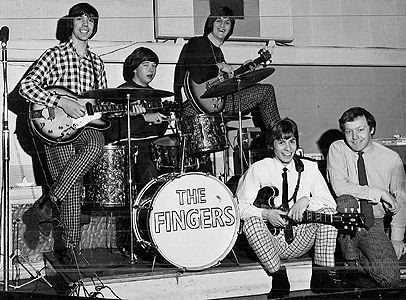
I joined The Fingers in 1965. They were a solid, tight band that played a mixed repertoire of songs at that time, including numbers by The Kinks, The Moody Blues and The Beach Boys.
The line up of The Fingers after I arrived was: Ricky Mills (lead guitar/vocals) Jim Spicer (drums), Dave Grout (rhythm guitar/vocals) and me on bass/vocals.
We added a very versatile keyboard player, Alan Beecham and when Jim decided to leave we turned to Bob Clouter to replace him. Our next change of line up was the addition of Mo Witham on lead guitar, which freed up Ricky Mills to develop his outstanding brand of showmanship. He really could make any audience eat out of the palm of his hand.
By recruiting Mo we now had four singers. Ricky was always our main lead singer but with four of us able to sing we began to experiment with four-part harmonies (sixths and ninths etc), falsetto tracked with the same notes an octave down and passing harmonies.
Alan was also helping the new line up to expand our repertoire by contributing jazzy versions of tunes like A Taste of Honey and we included various soul and Tamla Motown songs too.
A singular influence on The Fingers came about via our introduction to Peter Eden. Peter had been a co-manager of Donovan with the well-known songwriter Geoff Stephens, after hearing Donovan support the R&B band Cops and Robbers at a live gig in Southend in 1964.
Over the years Peter has played a part in records by artists as diverse as John Surman, G T Moore, The Crocheted Doughnut Ring, Barry Fantoni and Bill Fay.
Our manager, Dick Mountney suggested to us that the band needed some creative advice regarding our repertoire and our stage act and after talking to Peter we agreed to take him on as an additional 'artistic adviser.'
Peter had a totally different idea of what we should play, what we should wear and how we should publicise the band to the one that we had. The first thing he did was to radically change our song list by persuading us that the emerging west coast Greenwich Village acts were more credible than the soul and pop repertoire that we had built up.
The new influences were many and varied but the favourites were The Young Rascals, The Loving Spoonful and other acts such as Tim Hardin, plus some minor artists like The Trade Winds.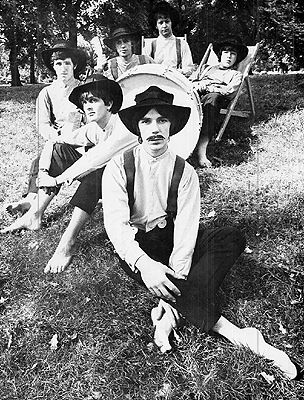
We were promptly geared up with grandad vests (well in advance of the coming trend); large hillbilly hats and wide braces (right). This quasi-country yokel look lasted for some time and in truth we did get noticed for it.
The band was itching to get onto the recording studio. An earlier self-financed session at Maximum Sound had resulted in us laying down a Geoff Stephens track Can't Live it Down and some covers like Look Away (later released on the vinyl only limited edition of Peter Eden productions called Nice) and also Something You Got. (Something You Got is still unreleased.)
David Wells of Tenth Planet Records (who has a huge knowledge of the era, the music and the records that were released in the sixties) compiled the anthology, Nice. Tenth Planet is one of the leading reissue labels around and specialises in vinyl, although it now has a CD offshoot called Wooden Hill.
One memorable evening was the Melody Maker National Beat Contest where we were 'guest stars' and we had to mime to I Go To Sleep in front of 2,000 people. This contest was hosted by Barry Kingston (a Top Rank DJ) and Emperor Rosko (from Radio Caroline.)
The Fingers also wanted to be on the radio and as we had passed our BBC audition we hoped that the release of I Go to Sleep would get us airplay. We had many plays on pirate radio stations like Radio Caroline and Radio London. For example we appeared on the Big L playlist in October 1966 with I'll Take You Where The Music's Playing. One of the Radio London DJ's (Keith Skues) had chosen this record as his climber but if failed to dent the Radio London chart. We did however; get to no. 32 with All Kinds Of People. Ricky Mills (backed by The Fingers) appeared in the Radio London chart a few months later as Daddy Lindberg. (Shirl was the record in question.)
We became chart climbers for other stations too and then our records became hits in some of the other pirate radio charts. Now this doesn't mean that they were hits in official charts but it did get us some interest from fans and the press.
The Fingers wanted to record a song that we were already playing in our stage act and in 1966 Pete agreed that we could try out I'll Take You Where The Music's Playing. This song was popular when we played live but again we were told that we could sing on the record but that this time very well known session musicians would provide the backing.
The lead guitarist was Alan Parker (later with Blue Mink) and Joe Morretti supplied the rhythm guitar. The pianist was a wild chap named Nicky Hopkins who recorded with many acts from the late sixties over a crucial period of two decades.
But that isn't all – our drummer for this session was Clem Cattini, the well-known musician from The Tornados. Clem's session history is long and very well documented elsewhere but just some of the artists that have been lucky enough to use his drumming skills are Mike Batt, Mike Berry. Phil Everly, Johnny Kidd & the Pirates, Hank Marvin, P.J.Proby and Lou Reed.
We were disappointed not to appear on 'our' record but we had to admit that the replacements were pretty good by any standards. The B-side was a Geoff Stephens song called My Way Of Thinking.
A New Musical Express reviewer commented on I'll Take You Where The Music's Playing in October 1966:
The Fingers recorded at Abbey Road (except for I Go To Sleep and the Can't Live It Down session both of which were recorded in 1966), and it was inspiring to be where so many big acts had recorded.
I'll Take You Where The Music's Playing flopped but Columbia (our then record company) still wanted to keep trying and we went back to Abbey Road to record the Geoff Stephens song All Kinds Of People, issued in 1967. This time we added harpsichord and although we were not fond of the song it still sounds quite fresh even today.
The B-side was a song called Circus With A Female Clown, which was co-written by Ricky and me, with help from Peter.*
In January 1967 the Record Retailer & Music Industry News said this about All Kinds Of People.
"One of the more way-out British groups but here in a surprisingly restrained mood. Neat vocal harmonies on a strong-sounding song – quite a few gimmicks. But a minor hit at best."
Circus With A Female Clown has appeared on various Psychedelic compilations such as Psychedelia At Abbey Road and Circus Days Volumes 1 and 2.
Peter had by now talked us into styling ourselves as one of the very first psychedelic acts in Britain. We experimented with strange lighting effects that were often built by Ricky from old speaker cabinets and record players, which supplied the moving parts for early strobe effects.
We made up stories for the press such as the fact that we allegedly stabbed a poor teddy bear to death on stage every night and that this wretched stuffed creature was full of lovely spurting tomato ketchup. We also had an entirely imaginary pet monkey that we said produced psychotic smells. These daft tales have resurfaced on the sleeve notes to some of the compilations that have featured The Fingers in the last few years.
Our next recorded effort (again in 1967), was another Geoff Stephens song called Shirl. We had used up our allotted recording time for the year so Peter booked us in as Daddy Lindberg; and The Fingers provided the backing for Ricky's new persona.
Shirl featured a Salvation Army bass drum which looked great on stage but which sounded awful on the record. We also used a mellotron that we found in the Abbey Road studio. We finished the session with about twenty minutes to spare but had no B-side. Rather than waste the time we wrote and recorded a stomping piece of nonsense called Wade In The Shade. (This was in February 1967.) Thirty-six years later this recording was featured on two separate Psychedelic compilations called We Can Fly Volume 3 (Past and Present Records) and Papermen Fly in the Sky (Paper Records.) This is what the sleeve note writers thought of our efforts:
"A great stomper which is starting to be recognised for the gem it is."
"Been on the DJ decks for a few years this one, but it's time to nail the beast onto 33 rpm. A smashing Peter Eden produced ditty that dips into Lysergic soup like a loaf of bread. Shirl its commercial flip stinks! & should be scratched from existence."
In February 1967 The Fingers appeared live on a BBC Light Programme radio show called Monday Monday. Barry Aldiss was the introducer and we were of course familiar with him because he was a well-known radio DJ of the time having first come to prominence via Radio Luxembourg.
At one gig we played with Hedgehoppers Anonymous and they said that they would get Jonathan King to phone me. True to their word I had a call at home from Jonathan who said he would be interested in managing and recording the band. The Fingers were very ethical chaps and when Jonathan phoned me I told him that we could not have him as our manager as we already had one locally. Who knows what would have happened if we had decided to ditch our friend and work with JK?
Our reputation as a psychedelic band was mentioned in the music press many times but the definitive quote for me comes from the Record Mirror of 05/11/1966:
"The Fingers are about as Psychedelic as Ken Dodd."
Geoff Stephens was talked about as the songwriter of 1967 (Record Mirror – 07 01 1967) and we did some sessions for Peter recording Stephens' numbers. One was for Barry Fantoni. My duties on a track called Bench Number Three At Waterloo Station were simply to play a roll on timpani every bar.
Other sessions that we did included some for the wonderfully named Vernon Haddock's Jubilee Lovelies. I sang the lead line on the choruses for an (unreleased?) recording of You Are My Honeysuckle. Bob Clouter and I also played with them on I'll Be Your Baby Tonight, a Bob Dylan song, which also appeared on Nice.
The Fingers were asked to audition for a tour for one of the major pirate radio stations and the tryouts were heard in a dusty and damp church hall somewhere in the outskirts of London. One of the bands had a pretty boy singer who the tour promoters liked but they were not happy with his band. They asked us if we would back the singer as well as appearing as The Fingers. You've guessed it – we turned them down. Oh by the way the singer was – David Essex! (We were particularly good at turning down what might have been good openings.)
I was interviewed for an article about psychedelia in Melody Maker, which surfaced in October 1966. I had been forewarned by Peter Eden that the interviewer, Chris Welch, was a jazz enthusiast and that provided I managed to say something about Charlie Mingus he would probably use my words of wisdom. Came the day, I waffled on about distortion, fuzz boxes and Charlie Mingus and my piece was used alongside an interview with the much more famous Graham Nash (of The Hollies.)
The Fingers used to enjoy playing the odd comedy numbers. At one time we did a small set by 'The hardest working man in show business – Nigel Grog.' Nigel was Ricky in a dirty old mac with a flat cap and the most hideous expression that Ricky could muster. Dave and I played ukeles and we gave immaculate renditions of George Formby songs like When I'm Cleaning Windows.
Now comes what is probably our biggest missed opportunity. After playing at a Carnival Dance in Stoke by Nayland we were told that the agent for The Animals was going to pass our details to Mickie Most.
 Mickie already had a successful stable of acts including Herman's Hermits, Lulu and The Animals so we thought it most unlikely that he would be interested in us. You can imagine that we did not really believe that a man as successful as Mickie Most would be interested in The Fingers. However, one night we were playing at a dumpy dancehall at the back of a pub in the Edgware Road, when who should stroll in but Mickie Most. He leaned nonchalantly on a pillar stage left and left after a few numbers without making contact with any of the band. We thought he was not interested until I had a phone call from him at home. He liked the band and wanted to send us to Germany for a while to tighten us up. The way he worked, he said, was that he wanted to be our manager, agent, record producer and publisher. He said that in return he would make us stars. But I again took the ethical (= naive) position that we already had a local manager that we couldn't just dump. Another golden opportunity vanished into haze!
Beat, Beat, Beat was an American Forces Network TV show that was broadcast from Frankfurt. We were booked to play on an eclectic bill that included Don Storer and Cherry Wainer, Sue and Sunny, The Tremeloes and The Equals.
The Beat Beat Beat producers in Frankfurt asked us to play I'll Take You Where the Music's Playing and All Kinds of People but we pleaded with them to let us do something more representative of our stage act. Eventually they relented and we did Most Likely You Go Your Way and I Go Mine, a Bob Dylan song and What Is The Reason? from 'The Young Rascals.'
Both these songs have turned up on compilation albums. One of them was The Early Days of Rock Vol 1 (Living Legend Records) and although I know that Volume 2 was issued in 1989, I am not certain of the release date of Volume 1, which featured 'The Fingers.'
These tracks also appeared on a French CD Nowhere Men Vol 4 – British Beat 1964 -1968, which was released in 2001. We didn't even know that they were being recorded!
Shortly after this German jaunt Bob and I left The Fingers and whilst they recruited very good replacements the band folded soon after they came back from another and longer visit to Germany.
* Webmaster's note: 'Circus With a Female Clown' is from the Pall Mall catalogue. Pall Mall Publishing was part-owned by Radio London.
The above feature and photographs are © John Bobin, 2006 and may not be reproduced without permission.
More about John's book, the group and their Knees Club membership, is in the Fab Forty for 22nd January 1967
The band reformed in 2012 in Southend for a one-off gig, a recording of which has been released on CD.