On
February 3rd, Radio London had been the first station and Kenny Everett
the first DJ, to play Strawberry 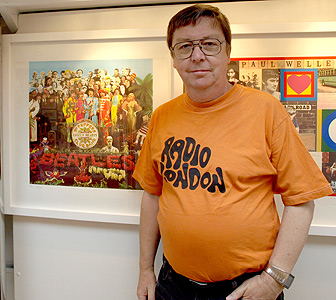 Fields Forever. Kenny had forged links
with the Fabs when he represented Radio London on the 1966 USA Beatles
tour. So turned on was he by Strawberry Fields that he played it twice
in a row, describing it as the most amazing record he'd ever heard. Fields Forever. Kenny had forged links
with the Fabs when he represented Radio London on the 1966 USA Beatles
tour. So turned on was he by Strawberry Fields that he played it twice
in a row, describing it as the most amazing record he'd ever heard.
However, on Friday, May 12th, 1967, even more amazing sounds were heard
on Radio London when the station got its biggest-ever exclusive - the
premiere of the much-anticipated Sgt Pepper's Lonely Hearts Club Band.
Kenny, who had been present at one of the Beatles Abbey Road recording
sessions, had already been raving on to anyone who would listen, about
how fantastic the new album was going to be. But it wasn't Kenny, who
had left Radio London in March, who got the Sgt Pepper exclusive. Now
working for the Beeb, he was unable to air extracts from the album till
eight days after Big L.
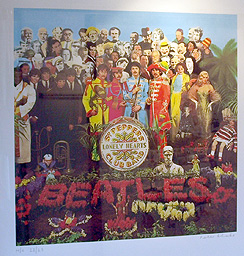
(Right) Radio London webmaster Chris Payne poses with a signed, limited-edition print of Peter Blake's artwork.
 Four
preview tracks from Sgt Pepper's had recently been heard in the US.
Paul McCartney had allowed A Day in the Life, She's Leaving Home, When
I'm Sixty-Four and Sgt Pepper's Lonely Hearts Club Band to be aired
on a small number of American stations when he took the new material
over to play for friends, but nobody had heard Sgt Pepper's (to borrow
a TW saying) in its entirety. Four
preview tracks from Sgt Pepper's had recently been heard in the US.
Paul McCartney had allowed A Day in the Life, She's Leaving Home, When
I'm Sixty-Four and Sgt Pepper's Lonely Hearts Club Band to be aired
on a small number of American stations when he took the new material
over to play for friends, but nobody had heard Sgt Pepper's (to borrow
a TW saying) in its entirety.
(Left) Blake's artwork
The album was scheduled for a June release and like everyone else, Radio
London had been desperately trying to obtain a preview copy, without
success. The story goes that on May 11th an unnamed young man arrived
at the Curzon Street offices, bearing a reel of tape. His equally-anonymous
girlfriend worked for EMI and he explained that she had secretly taped
the new Beatles album during a staff production meeting, using a tape
machine secreted in a shopping bag. The couple was not even trying
to cash-in on such an amazing opportunity. They had deemed it their
public duty to present the tape to Programme Director Alan Keen so that
their favourite station, Radio London, should be given a world exclusive.
As might be expected from a recording made on a low-speed portable recorder
from inside a shopping bag, the sound quality of the illicit tape was
very poor.
 Alan immediately phoned music publisher Dick James and told him about
the stolen treasure he had in his possession. He said that if Dick didn't
give Big L an exclusive preview copy of Sgt Pepper's, the station would
air the bootleg recording, warts and all. True north-sea piracy! Alan immediately phoned music publisher Dick James and told him about
the stolen treasure he had in his possession. He said that if Dick didn't
give Big L an exclusive preview copy of Sgt Pepper's, the station would
air the bootleg recording, warts and all. True north-sea piracy!
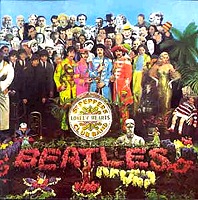
(Left) The printed sleeve
EMI chiefs had always been very anti-offshore radio, believing that
a large amount of airplay reduced, rather than enhanced, their sales
figures. The company's preferred method of promotion was via sponsored programmes on Radio Luxembourg, which normally featured only part of the song. The thinking behind this was 'leave 'em wanting more - if they like the bit they've heard they'll go and buy the single'. Other record companies strongly disagreed and felt that getting
as much on-air exposure as possible was the easiest way to produce hits. One
example was Tony Hall of Deram, who had asked Alan Keen to give 'Whiter
Shade of Pale' a trial spin, as a favour. Just one play 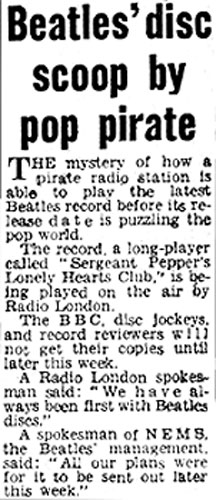 provoked an
incredible public response and with further assistance from the offshore
stations, the record went on to become a huge international success. provoked an
incredible public response and with further assistance from the offshore
stations, the record went on to become a huge international success.
Some have said that the ‘bootleg tape’ story was merely invented
to blackmail EMI into giving Radio London an exclusive. Admittedly,
the tale does sound somewhat far-fetched and is compounded by the fact
that the participants have remained unnamed since 1967. But whether
or not the boyfriend, his girlfriend or indeed the tape ever existed,
the ploy worked! Dick James agreed to supply Alan Keen with a proper
tape of Sgt Pepper's on the proviso that he did not reveal where it
had come from. As a music publisher, allowing a radio station an unauthorised
copy of the album could have landed James in a lot of trouble.
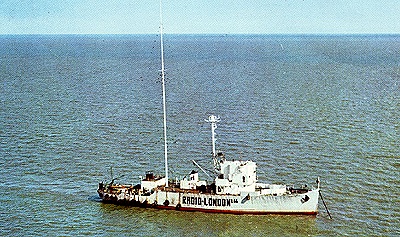
Aboard the Galaxy, administrator Richard Swainson was called on the ship-to-shore communicator to come
to London to collect the promised tape and remembers the occasion very well.
"I had received a ship-to-shore call from Curzon Street on Thursday 11th, asking me to be ready to come off the Galaxy the following morning. The office would contact me again as soon as there was any more information. I received another call later that day to say that all was go and that the tender would collect me early the next morning and to be ready. I was told that somebody would meet me at Liverpool Street station. I still had no idea quite what was going on, although we had our suspicions.
When the tender reached Parkstone Quay, I phoned the office to let them know what time I would arrive at Liverpool Street. On arrival, I was told what was going on and what it was we had got. The person who met me told me that a tender would be standing by at Parkstone to take me back out to the ship.
I arrived at Dick James' office and he told me that if anyone ever asked me anything about (where Big L got the exclusive), I was never to mention his name. He was extremely friendly towards me and asked if I had any idea what time the first play of the album would be. I told Dick that I would contact him about it as soon as I could.
I arrived back at Parkstone Quay at about 3.00pm and on our way back out to the ship, I got in touch with Ed Stewart to let him know what I was bringing and that the tender should be alongside the Galaxy at approximately 4.30pm. I told Ed to start trailing the fact that we would broadcast the Sgt Pepper album as a Big L exclusive at around 5.00pm and the rest is history. It was a long day, but what a coup! Everybody on the ship was over the moon."
Everyone from the DJs and personnel
aboard the ship and the management ashore, to the listening public, held
their collective breath.
A sponsored segment called
'It’s All Happening' that went out every Friday between 1700 and
1800 as a 'What's on in London' guide for trendy youngsters. It
was during this part of the show that Stewpot introduced Sgt Pepper's
Lonely Hearts Club Band, no doubt to the delight of the sponsors. Naturally,
everyone aboard the Galaxy had gathered round to listen. The sounds of Sgt
Pepper's had such a profound effect on John Peel that he burst into
tears, so Ed took pity on
him and allowed Peelie to take over the programme. The album did not
merely get one airing. Everyone on the station was so bowled over by it that it was
played in full several times that evening.
Stephen Chesney pointed out that one aspect of the above story puzzled him. By May 12th, Stewpot no longer held the 3 - 6 slot having moved permanently to 12 - 3.
Alan Field says: "The dj shifts changed immediately after Kenny Everett left Radio London on 21st March 1967, and Ed was six or seven weeks into his new lunchtime gig by 12th May. I'm sure he wouldn't normally be brought back at 5pm on a Friday to present 'It's All Happening', but this was no ordinary occasion.
As senior dj, the honour of unveiling the Sgt Pepper album naturally fell to Stewpot. I think that, having an idea of the mission Richard had been sent on, Ed may have swapped shifts in advance to come on air at 3pm that day. If he did in fact do his regular lunchtime show, then on receiving Richard's call from the tender, Ed must have either stayed on air after 3 o'clock, or returned to the studio some time before 5pm. That would tie in with reports of Ed trailing the Sgt Pepper feature on air, which he wouldn't have done until after Richard's call.
I guess we'll never know for sure, but it's fun remembering the occasion and trying to work out the timeline 50 years on."
Hans Knot's recording of the moment Stewpot announced the album's arrival.
 Richard Swainson alleged that although Sgt Pepper's was aired with the Big
L PAMS jingles played over the tracks to prevent any further bootlegging
by rivals, the Caroline DJs were so keen to get their hands on it that they recorded it
off air and played it to their own audience, Radio London jingles and
all! Richard Swainson alleged that although Sgt Pepper's was aired with the Big
L PAMS jingles played over the tracks to prevent any further bootlegging
by rivals, the Caroline DJs were so keen to get their hands on it that they recorded it
off air and played it to their own audience, Radio London jingles and
all!
As Dick James had predicted, EMI bosses went mad. The MD Ken East phoned Alan Keen to threaten a
police raid if Radio London did not stop playing Sgt Pepper's, but Alan
cleverly told him he would have to take his complaint to Radlon Sales' registered office
in the Bahamas!
The Beatles' publicist Tony Barrow revealed that he had no objection
to Radio London playing the album early, and neither had the Fab Four.
In fact he believed that this early airplay was responsible for EMI bringing forward the
release of Sgt Pepper's by a week. It came out
twenty days after its first outing on Big L.
Journalist David Hughes admitted that because Disc and Music Echo had
been given no preview copy, he had been able to write his review for
the paper only by listening to the album via a small transistor radio, as it was
played on Radio London.
It was May 20th before Kenny Everett got to play Sgt Pepper's. He and
fellow ex-shipmate Chris Denning were now working for the BBC and Kenny
aired extracts from the sensational new album on the Light Programme,
during Denning's show 'Where It's At'. Needle time restrictions at the
Beeb would not have allowed the album to have been played in full.
Sgt Pepper's caused such a stir that Alan Keen then took the unprecedented
step of placing the grand finale track 'A Day in the Life' –
never released as a single – at number one in the Big
L Fab Forty for June 11th.
Richard Swainson says: "That was Alan. He said, "On something like that you should go mad. You should do that. Not only will it cause a bit of controversy and get a bit of publicity, I think it will make quite good programming.' That was Alan's decision and it was very good. Everybody, including me, when the memo came out, thought, 'How can you do that when it's not even a single?' but it did cause a lot of talk and it was good. It worked very well."
Meanwhile, the Beeb banned the track, citing
lyrical drug references. Like most bannings, this move merely enhanced the existing publicity. |
 Sgt
Pepper's third cut, Lucy In the Sky With Diamonds, was also the subject
of much discussion and dissection as to whether or not the song referred
to the psychedelic drug LSD. John Lennon, however, always maintained
that the song was inspired by a painting brought home from school
by his young son Julian, then aged four.
Sgt
Pepper's third cut, Lucy In the Sky With Diamonds, was also the subject
of much discussion and dissection as to whether or not the song referred
to the psychedelic drug LSD. John Lennon, however, always maintained
that the song was inspired by a painting brought home from school
by his young son Julian, then aged four.